Jax, Me, and the Surf

Jax, Me, and the Surf
Showing posts with label flow. Show all posts

Saturday, May 28, 2011

Picture Update

It's been two or three weeks since the last pictures.  Here's how things are going...


Mushroom Update
Mushrooms Before
Mushrooms Current
Here is a comparison of the mushrooms.  If you look closely, you can see how they've increased in density.  Within the past few weeks, heads have begun to "pop off" or remove themselves from the colony.  About four so far have done this.  I've assisted each of the four heads in relocating in the hopes they will re-attach.

This is the rock immediately below the mushrooms.  The first two head that removed themselves were put here, but they ended up falling inside a hole in the rock when they closed up.  I'm not sure if they are both OK, but one pops out mid morning through this hole.

This is the fourth head that removed itself from the colony.  There was a little too much flow around the third head for it to attach in the same place, so I moved it up and to the right of the current colony.

This was the third head to remove itself.  This had no hands-on intervention by me.  It found a slow-flow area and was able to attach itself.  This rock is below the current colony and up in front on the tank.

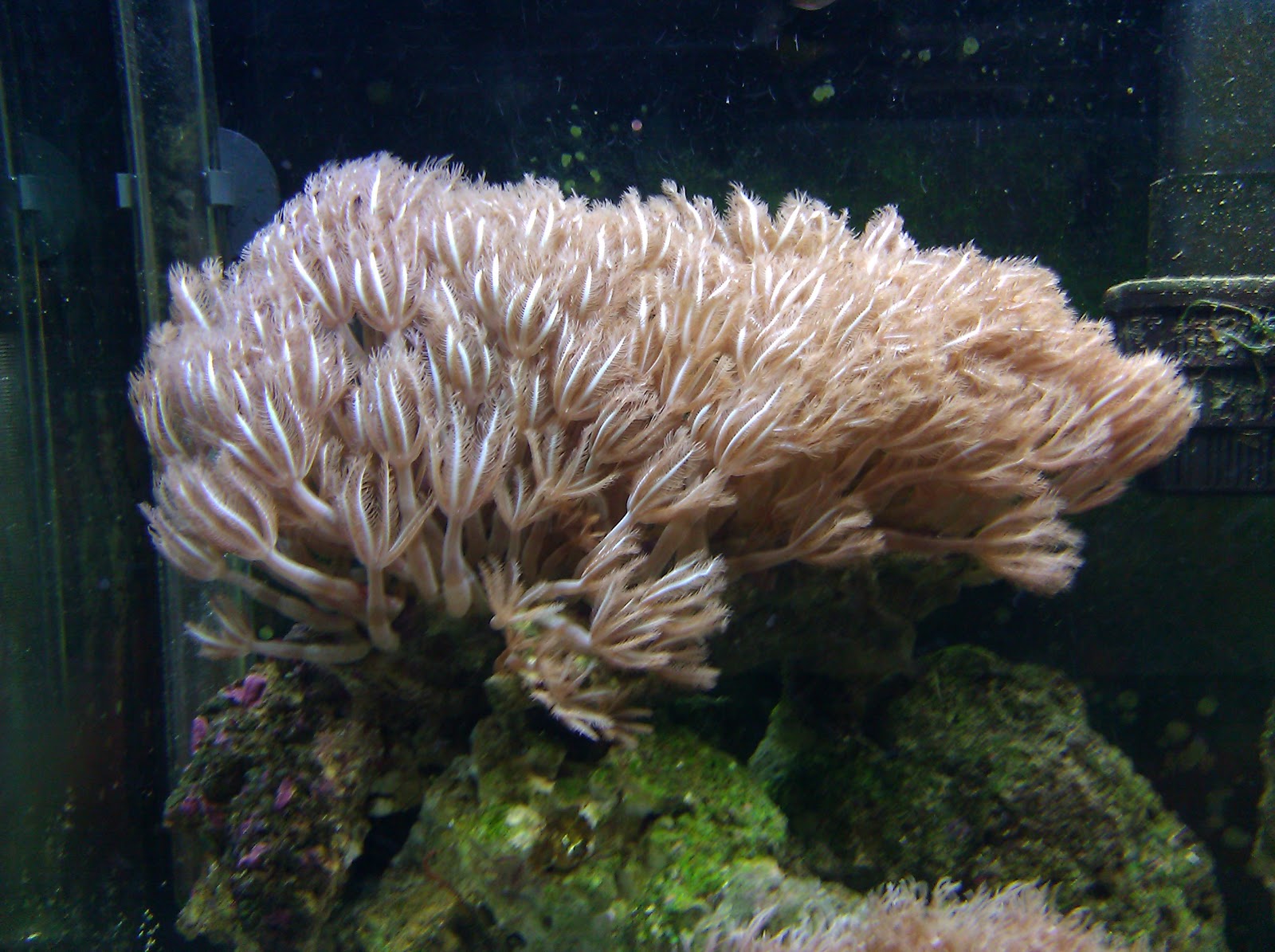
Anthelia Update

Anthelia BeforeAnthelia Current
Not much to say about the Anthelia except it, too, has gotten more dense. I suppose it's only a matter of time before they start removing themselves from the colony and setting up shop elsewhere in the tank.

Star Polyp Update
Star Polyp BeforeStar Polyp Current
This may not be a fair comparison - the image on the left is effected my a majano anemone (just right of center) and a few aiptasia (left edge).  There are still a few aiptasia on the current photo but their placement does not effect the polyps as much as before.  I don't know if I necessary noticed this coral spreading, but in the places it is, it certainly looks better.  Also picture at the bottom left of the rock, a calciferous worm has taken up residence.  That is the horizontally running "white tube" just to the left of the bottom-most cluster.

Neomeris annulata update


N. annulataN. annulata Current
The single "seedling" bleached out after the first picture was taken.  It happened during a time when the power filter was put back into use.  This tells me that nitrates need to be at or below 20 to have this algae.  The current picture isn't the best, but it's amount of spread can be distinguished by color alone.  Nitrates run no higher than 20 in the current setup.


Here's how the anemone is doing.  The male clown can be seen underneath and to the left tending to the eggs they've recently laid.

This particular rock has a sponge that is getting bigger.  It's also accumulating a lot of pineapple sponges.

Tuesday, April 26, 2011

Once Again, Power Filter Changes - Undone

Removing the filter pads from the power filter did no good.  The layer of skim was still at the surface of the water even though the filters output was churning the layer.  However, with a lack of filter pad, the larger particulates were being swept into, then right back out of, the power filter.

So today I picked up some new filter pads and also two Hydor Koralia 425 power heads.  The pads are now in the filter to clean up the particulates in the water, and the nano power heads are installed to assist with lessening the dead spots caused by the flow of just the power filter and 750 power head.  I'm sure some tweaking will need to be done to the additional flow. I'm only hoping they're powerful enough to do what I need them to do.  They sure don't put out much.  But I was worried about having too much velocity in the tank, so they'll have to do.

Noticed tonight a bunch of "chaeto bugs" on the power filter input.  I wonder if the tank is feeding on them at all...

Sunday, April 17, 2011

So It Would Seem & Thoughts About Past Failures

The "standstill" of diatoms and cyanobacteria has ended, which is a shame.  One step forward, one step back.

However I may know the cause.  During the last water change, I neglected to rinse out the power filter.  I'm sure it's pumping out a huge amount of nitrates - so much that the chaeto is leaving left-overs for the diatoms and cyano.

Just to verify, I'll monitor the tank following the next water change/power filter cleaning.  As it stands now, that won't be too long.  I project my next water change to be necessary by Wednesday, and that's without a test strip even hitting the water.

I'm wondering if I might be able to make a DIY "chaeto box" out of my filter.  I'll have to ponder that deeper before implementing.  Initially I'm thinking of removing either the filter or the media cartridge and replacing it with chaeto.  The area housing the chaeto will need to be lit, but I'm wondering if that will also cause nuisance bacteria to also grow inside the power filter canister.  This would provide a lot of flow over the chaeto and perhaps even give the chaeto a chance to suck up nitrates before re-entering the tank.

So many things needed in order to remove the power filter for good:

  • Flow will be reduced - countered by additional power heads
  • Large particle filtration will be eliminated - countered by a detritus collection area which will require a return pump, collection container, and an overflow box.
  • Surface film will return - countered by an overflow box, but this layer would not necessarily naturally collect in a collection container since it floats.  Could also be countered completely by a surface skimmer - more research needed.  
  • Surface film also inhibits gas exchange - countered by power heads aimed to break surface tension.
So my shopping list to remove the power filter once and for all is:  power heads, return pump, collection container, overflow box (plus required tubing and fittings), a potential surface skimmer, and more power heads.  That looks like an expensive list...

Off to greet tomorrow.

Monday, April 11, 2011

Potential Anemone Preventative Care

Just a few (hopefully) quick things...

Noticed the anemone has had some what appear to be "irritated" tentacles.  They are shriveled and white.  I've noticed the clowns picking on those tentacles the last couple days.  Those tentacles just so happen to hang over the bowl edge to where they may be coming in contact with the anthelia.  I don't know if anthelia "stings" or not, but I moved it away from the anemone bowl.  I haven't yet looked to see how much flow the anthelia requires.  It's in "low" flow now, so I may end up moving it again to a better flow spot.

Since I moved the anthelia, I'm thinking of moving the remainder of the rock adjacent to the anemone bowl to avoid future coral contact.  That will be for another day.

I scrubbed cyanobacteria from a few of the rocks also.  While I was at it I went ahead and kept on brushing. Did all the rocks except the anemone bowl.  If the power filter wasn't installed, I probably would not have done that just due to the amount of detritus that was stirred up.  So now I'm waiting for the "dust to settle" so that I can hand out some mysis.

The surface film on the tank was about 75% gone... at least until I started stirring up the substrate and brushing rock.  I don't like stirring all that stuff up at once.  I don't know what effect it has on the inhabitants.  Maybe I'll start spreading it out over the course of a week instead of everything at once.  Speaking of which, I expect a pretty full skim cup tomorrow.

Nitrates are still at 10.  Just another patience game to play with the chaeto.

Found a dead shrimp today.  Judging by the location of the shrimp I see on a daily basis, I'm guessing the carcass I found was the new one.  Time to update the tank specs to reflect the change.  I still think I need to have a total of at least 4 just to keep the "territory" covered.  But those will have to come with time.

The first shrimp I got was a nice pink, even during acclimation.  The second shrimp was brown the whole time until it was in the tank for 10 minutes or so.  Then it turned pink, but I wonder if that had anything to do losing it.

I suppose that's it.

Sunday, April 10, 2011

Slow Day in the Tank

Slow days in the tank get me thinking:

  • Since removing the power filter, I've developed a thin skin of compounds on the surface of the water.  These compounds need to be skimmed, but, due to my lack of current equipment, they cannot be.  I can point my single power head enough toward the surface to disturb the water, but a majority of those compounds are just too big to be skimmed by my equipment.  Also, when the power head is adjusted, the anemone seems to need to readjust.  I like him where he is.
  • With these compounds collecting at the surface (due to their bond with a hydrogen atom, they float) the gas exchange between the water and the surface is negatively affected.  At least the power filter would disturb the water tension to allow for better gas exchange.  It also has the effect of tumbling this film which allows the skimmer to grab what it can in addition to the filter capturing the larger particles.
  • Also without the added flow the power filter provides, I have more dead spots in the tank for detritus to settle.  That means more frequent vacuums, which equates to more maintenance and more salt mix.
I think my list of "pro's" to keep the power filter in the tank was not thought out enough.  And since adding the chaeto, I've at least taken a step to stem the tide of the power filter's big negative effect.

So guess what - the power filter has been reinstalled.

I hate the fact that I simply cannot keep my hands out of the tank for more than a week.  However, I want the best for the tanks inhabitants.  I am not afraid to experiment to improve the conditions of the tank.  I am also not afraid to undo any changes I make if those experiments net a negative effect.

The chaeto will simply be my low-budget nutrient removal device until I can afford an under-the-tank solution.  And the chaeto will benefit from the installation of the power filter as well.  Due to the chaeto's location in the tank, the power filter will provide plenty of flow to it.

I also took some pictures today.  

The mushrooms are doing surprisingly well. They aren't spreading yet, but they are getting larger.


The anthelia is doing well.  It seems to be getting nice and thick.  It, too, has not yet started to spread.

I can almost see the anemone growing day by day.  It now easily "over-flows" the bowl it resides in.

The star polyps are NOT doing so well.  The aiptasia at the bottom left has stung enough to create a purple barren spot.  And the dark brown coral right of center seems to be doing a similar thing to it's neighbors.  I am hoping to get the aiptasia removed next week since the peppermint shrimp aren't interested in it.

Tuesday, April 5, 2011

Treading on Thin Ice

I feel like I'm tempting fate.  Once again I have removed the power filter from the tank.  I feel, though, that I can breathe a little easier this time around.  I'll have a solid 4 hours to keep an eye on water conditions before I need to leave, and my wife will be home to do anything necessary soon after that.

In my mind, I KNOW that the power filter is doing more harm than good.  It provides large particle filtration (so less items on the substrate) and it provides some flow in the tank.  But with the cost of those two "good" things cause a big bad thing...

Power filters are great environments for aerobic bacteria - the bacteria needed to convert ammonia to nitrite and nitrite to nitrate.  However due to the flow contained within them, they are absolutely inhospitable to the bacteria that is necessary to complete the nitrogen cycle.  Those bacteria need an anaerobic environment to live - like inside rock and such - out of the way of the flow.  So the power filter continuously pumps out nitrates and due to a lack of anaerobic bacteria, that nitrate never gets converted to nitrogen.

I'll be keeping an eye on it.  I may, just for my sanity's sake, perform a water change today or tomorrow.  The water's OK, it's just that it helps me mentally :)

I have one concern: Since adding the new inhabitants, the ammonia levels are just now beginning to decrease. A necessary amount of the bacteria that allows that to happen reside in the power filter. With the filter removed, the levels of ammonia, nitrite, and nitrates are going to rise until "replacement" bacteria grows to fill demand. I should plan on doing every-other-day water changes to avoid repeating my last tribulation, if indeed that is what caused out.

Guess I'll get one going now. I'll be able to work without worrying about it all day.  I'll re-run the tests to have a baseline when I do.

Thursday, March 24, 2011

Observation - A Lack of Activity Leads to Closer Scrutiny

So it's been 4 days now since the Damsels were removed.  I bet it's going to be another month before we get any fish back into the tank.  When it rains, it pours.

So with only 10 Dwarf Hermit Crabs, the needles on the gauges seem to be winding down.  After four days, nitrites are nearly at zero.  There is more than one thing going on that effects nitrates, so I'm not putting a lot of weight on it's results quite yet, but I will keep an eye on it to see if I can determine if nitrates are being converted to nitrogen.

If I would have known it would be so long before replacing the Damsels, they'd still be here.

So the tank is a lonely place now.  With fish AND crabs, the fish would draw me in, then I'd begin to study the crabs.  I still gaze into the tank habitually only to find three or four crabs within view... not much to see.  But habits are hard to break.  I now study the rock.  With the addition of flow, I can see detritus attached to the rock waving in the current.

As I go from rock to rock, I've begun to notice some algae.  I'm curious as to what it is - at least it's a nice shade of green instead of the brown stuff (not that the brown algae is gone).  Chances are it's nuisance algae, but at least it gives me something to do.

Once in a while I'll see a nice big piece of detritus resembling a dandelion seed.  Flow doing it's job:  CHECK.

Monday, March 21, 2011

Step Two of the Journey Almost at an End

Busy day and I'm beat.

About 8:30, I got started:

I was able to find all 10 crabs and remove them safely from the tank.  I housed them in a small bucket along with a small piece of live rock for them the play with while they waited.

Next came the live rock.  I removed all the pieces and placed them in a tub with some tank water.  Forgot all about shaking them off in waste water... ended up shaking them up in the tank before removing them.  Just that much more to vacuum.  I'll chalk that one up to lesson learned.

With only the 6 Damsels and substrate remaining, I began to vacuum.  The first 3 or 4 buckets were just the surface detritus - mostly from shaking the rock in the tank instead of waste water.  The next 10 or 15 (I'm estimating, wasn't keeping track) buckets were from deep vacuuming.

When the waste bucket got full, I applied the strainer to the top of the bucket and gently dumped all but a gallon or so back in.  Sometimes I'd let the bucket settle a bit, other times not.  The strainer seemed to work great at keeping the visible detritus in the bucket.  Not back for $4.

Then in came time to wrangle up the Damsels.  I only netted 5 of the 6.  Somehow, one of the Domino Damsels physically disappeared.  So I bagged up 5 Damsels instead of 6.  I figured the Damsel may be in with the rock.  But I did clean them off pretty good before removing them from the tank...

The live rock was then placed back in the tank.  I hate how it looks now.  I'm going to have to mess with it a bit...  Maybe study some photos and videos to see what went where.  No Domino Damsel.  The other Domino Damsel perished while bagged.

Then off to the LFS at 11:00.  Grabbed 10 gallons of RO/DI saltwater, a 750gph powerhead and a 6 in 1 test kit, and was credited some money for the return of the Damsels.  They must have thought I was bullshitting them when I mentioned how I lost more Damsels today than in the two months of having the tank, especially when I pointed out that one was physically missing.

I pulled out another couple gallons of water just to make sure I had room for the 10 I bought.  If a person finds out there's not enough room in the tank for the water, it's already too late to do anything about it.  Ended up pulling out too much water overall.  I could probably use at least another 5 to fill it completely.

Installed the powerhead, aiming down and along the back stretch of the tank behind the rock.  For now, it's something to help the rock purge itself of nutrients and to keep detritus suspended longer, allowing the filters a better chance to grab it.

The water is still a bit cloudy from all the substrate and rock work.  Detritus floats around roughly counterclockwise and stays suspended in the water.  Gone are the days where the tank would clear up (usually by settling) in an hour or so.  I'm curious if I'm still going to have daily skimmer dumps...

I'll let the tank clear up for a day or two, then we'll see about Clownfish.

Still no Domino.

Step Two of the Journey Begins

Yesterday was Jax's one year birthday party.  This is week I've been waiting for.

First order of business will be to pick up another 5 gallon "Homer" bucket and two lids for the two buckets I already have.  I've run out of salt mix and will now begin purchasing premixed RO/DI water for a buck a gallon from my LFS, and I'm going to need probably 10 gallons, plus some room to drip-acclimate today.

Second order of business is to temporarily remove the Dwarf Hermit Crabs from the tank.  I'll be needing to move around rock in the tank to get to the Damsels so I'll probably end up putting some of the smaller rock into a temporary container, then add the crabs to that so they aren't so uncomfortable.  They may be in there a couple of hours.

Third order of business will be to get the six Damsels bagged up and returned to my LFS.  I may need to remove some of the rock from the tank completely in order to catch those elusive fish.  That's OK, though.  The tank is going to get a good vacuum and scrub today.

Fourth order of business will be to get the tank cleaned up.  I've been gaining insight on the science of reef tanks from the Reef Tank forums, specifically about "Reef-keeping Made Easy", Lighting, and Detritus.  These three threads alone, though some may be some very deep reading, have bolstered my confidence and gone a long way toward keeping the guess-work out of this Journey.  It has also dispelled some myths and some of my preconceived notions about biodiversity in the tank.

I will be vacuuming the crushed coral bed more thorough than I ever have in the past.  For this I am going to need a water pump.  Usually when cleaning the substrate, I only have enough time to quickly vacuum about one third of the tank due to my 5 gallon water-change bucket filling so fast.  What I'd like to do is to modify one of my buckets to house a water pump that will return water to the tank.  This will, in effect, give me a limitless amount of capacity in the bucket in order to completely clean the substrate.  If I'm able to accomplish this, I may feel safe changing water every other week instead of weekly.

Edit - After picking up some additional buckets at Home Depot, I ended up finding something I'll try in lieu of a "pump bucket"...a 5 gallon bucket paint strainer.  It's sort of like a hair net for a bucket.  We'll see if that will hold the suspended detritus in the bucket while I pour the water back in to continue vacuuming the substrate.  Remember - my goal is to remove as much detritus as I can initially, then perform a 10% water change.  It doesn't matter how many times the "waste water" goes back into the tank as long as the detritus stays in the bucket AND i pull out 8 gallons when I'm done vacuuming.

Once I'm done with the substrate, I will turn my attention to the power filter.  Currently, like my substrate, it is a nitrate factory.  Before dumping the waste water from the substrate cleaning, I'll thoroughly clean the pads and impeller, and rinse out the interior.  Once it's clean, it's future cleaning will be included with the substrate cleaning (still learning as I go).

Fifth order of business will be to get the live rock put back into the tank (if it needs to be completely removed, which is not a bad idea - detritus will settle underneath them) after giving them a good shake in the waste water.  This will remove a lot of the detritus from the rock surface allowing the rock to begin purging itself of nutrients once again.

Sixth order of business will be to introduce "flow" into the tank.  This provides a multitude of benefits:
  • Detritus and other nutrients are suspended in the water column longer allowing the power filter and skimmer a wider window of opportunity to do their job.  Decreased particulates in the tank translates to lower ammonia and phosphate production which both cause positive chain reactions on down the line.
  • With flow, live rock will have the opportunity to wick nutrients to their surface and subsequently into the water column in order for those nutrients to be removed.  Substrate will have a similar benefit.
Seventh order of business will be to introduce new flora and fauna into the tank, a.k.a. "First Fish" and "First Coral".  We've decided upon the Clownfish (but not which species), but not yet on the coral.  That will heavily depend on the stock currently available at my LFS.

It's going to be a busy day today.  I'm going to do my utmost to ensure our new arrivals live happy, healthy lives.

Sunday, March 20, 2011

Observation of Adding Live Rock to a Newly Established FOWLR

A week ago, as previously mentioned, I brought home 15 pounds of live rock and 10 Dwarf Hermit Crabs.  For the past three or four days, the protein skimmer has been collecting a lot more than I'm accustomed to seeing it collect.

Up until now, I emptied the skim trap about once a week, or three times every two weeks.  There would be about half an inch to three quarters of an inch of skim.

Now I'm seeing that much collected within an 18 hour period.  I've been dumping it daily for the past few days.  In the past, I've never seen the bubbles filling the trap.  They've always just remained at the top.  Now I have bubbles filling the trap except, of course, where the skim takes over.


So I wonder what's happening here?  Could 10 less-than-one-inch crabs be increasing the detritus in the water column by an estimated factor of 10?  Six Damsels occupy the tank.  I don't quite think the crabs equate to 54 more Damsels (which would produce nutrients by that same factor of 10).

Already having 35 pounds of live rock, I, in essence, added an additional 43% of live rock.  Does that translate into adding an additional 43% of nitrifying bacteria to the tank?  Maybe not, but it's not a horrible estimate.  With ammonia and nitrite readings effectively at zero for the past 4 to 5 weeks, I've potentially added 43% more bacteria without increasing their food source (ammonia and nitrites).  Is this potential ammonia- and nitrite-starvation causing the nitrifying bacteria to reduce in population to a more sustainable number?  Seems sound to me, but I'm no rocket surgeon.

I think the solution lies with both the large percentage of live rock added AND the crabs, with just a sprinkle of "lack of flow":

Sure, I added some animals to the tank along with the new live rock, but not enough to increase the amount of ammonia in the tank by my estimated 43%, which would be enough to feed the addition of 43% more nitifying bacteria.  So some of these bacteria must be starving and dying off.

Without a powerhead (as of yet), the most flow that my live rocks and substrate gets is a very light flow from the power filter, which only effects the half of the tank the power filter is in.  So there is a bit of "marine snow" sitting on my rock and substrate.

Watching the crabs, they tend to sift through this "snow" while grazing upon the substrate and rock.  The first day they were introduced into the tank I noticed them tossing up a decent amount of white particulates.  These particulates are particles that are decomposing and contributing to nutrient production.

My logic (whether false or not) is leading me to believe that the crabs are causing the increase in skimmage, not due to their bio-load in the tank, but by their behavior of tossing "snow".  Remember, I have yet to introduce any flow to speak of to the tank so the live rock is not able to "clean" itself.  To compound the issue, I've added an approximate 43% of nitrifying bacteria without an equivalent increase in their food supply.  I believe the dead bacteria now contributes to part of my detritus.

This leads me to believe that I can expect another increase in skim production once flow is introduced into the tank.  Flow will, in essence, be performing the same function as the crabs seem to... dusting off substrate and rock.  If my logic is sound, skim production will increase, but also will not last as long as the crab-induced skim production will.

Prior to the introduction of the crabs, I was more than likely "under-skimming" - more "dead organic compounds" were being introduced into the system than were going through the skimmer.

Now that the crabs are sifting through protein particles while grazing, I have a little catch-up to do.  More (hopefully, anyway) DOCs are making to the skimmer than are being created.

With the addition of flow in the next couple weeks, I feel confident that more nutrients will be skimmed than generated, allowing me to get caught up and then begin to find a new "normal" with the skim trap.

So now that I'm at the end of my thought process, the title of this entry seems misleading.

Comments?  Alternate theories?

Saturday, March 19, 2011

The Short List for the Near Future

Damsel's are small, pretty, and have a relatively small gallon-per-fish requirements.  But they're also pretty territorial.  If they aren't eating, they're usually attempting to dominate one of the other Damsels, except for the smallest - he only has the hermit crabs to pick on.

So in the next couple of weeks, the plan is to bag up the Damsels, which is no small feat.  In my many weeks of studying them, I've found that they are particularly adept at hiding and fitting into tight spaces.  End result - the live rock is going to have to be either removed from the tank completely to catch them, or at least I'm going to have to arrange it to avoid any nooks, cranny's, or hiding spots.

I've heard of fish traps but haven't really looked into them.  I'm going to want to bag these guys up pretty quickly.  My entire life has taught me that traps will generally sit empty and I just don't have inclination to make multiple trips to the LFS to drop off fish a couple at a time.

Back to moving the live rock around... I now have hermit crabs, so they will either need to be temporarily removed from the tank or I'll need to be careful moving rock around.  There are only 10 in the tank (I've only been able to spot 9 at any one time), so moving them to a temporary bowl or cup should be the easiest way to go.

I'm thinking our first fish will probably be a Clownfish, which I'm sure is a very common choice.  It's actually a close race between a False Percula Clownfish (Amphiprion ocellaris) and some sort of Tang - and due to the cost of Tangs, more than likely a Blue Hippo Tang (Paracanthurus hepatus).  If it weren't for the "Nemo" themed birthday party this weekend, the Tang may still be in the running.

Personally, I'd prefer to have a handful of other types of Clowns, but I'm a little limited in what's available at my LFS - I'm not yet adventurous enough to hit other saltwater LFS's or order online.

I've been doing a little research on the Clown which is beginning to sway what the first coral will be.  Still undecided, but I seriously doubt I'm coming home with a mushroom on that day.  I can't really visualize a clown claiming a mushroom.  No real hope in deciding now what coral to start with... I'm not familiar enough with the LFS selection, but I'm going to shoot for something that at least remotely resembles and Anemone, if possible.

I've also read the Clownfish live in small groups - so there's hope for a handful of Clowns living (hopefully) as they do in the wild.

Also with the first fish and first coral, I'll be bringing home some "flow".  The LFS and I have talked a bit about what I'll need.  He recommended a 750 gph powerhead for the end of the tank opposite of the backpack filter... makes sense - the filter is already producing a little flow down on it's end.  It was also suggested that in the future, if more flow is needed, get a smaller powerhead for the filter end to add just a bit more flow.

I'd also like to feed the fish a more varied diet in the future.  So I'm thinking Reefpods - they feed on detritus so they're a part of the "janitorial crew".  I've read that they love to live in Chaeto, and Chaeto helps with Nitrates.  I saw today where someone liked the look of "grass" in their tank, so they just balled up some Chaeto and nestled it in the corner.  I realize that's not the most efficient use of Chaeto for removing Nitrates, but I can see that it's a happy medium for dual use - removing Nitrates and housing Reefpods.  I don't yet have a refugium, so it doesn't sound like a half-bad idea, especially if I have some flow in the tank.  Who knows, maybe when I do get a refugium, I'll still have Chaeto in the main tank just for another Reefpod shelter...  (I have since gained insight that deters me from this action)

Eventually I'd also like to start making a little money (or losing less, whichever the perspective is) in saltwater.  I'm tossing around ideas for selling beginner fish and corals, but that's going to take a lot of equipment, time, and work (not to mention space).  But I've been in business before and baby-steps are OK with me... I'm used to it.

Look what happens when a guy brings a salt tank home for his son...

... and this is just short list (figuratively).

I guess I'll go get that water change done.