Jax, Me, and the Surf

Jax, Me, and the Surf
Showing posts with label clownfish. Show all posts

Monday, August 15, 2011

Daylight Update

Still in the photo taking mood.  Here's some shots w/ the daylights on.  Nothing else, just pics.


Tuesday, June 7, 2011

Breeding Preparation - Clownfish Larvae

The following post is simply a place for me to get thoughts into the physical world and to compile information found from multiple places into one.  This post is a work in progress.

Items Needed:
  • Larval Snagger
  • Brine Shrimp (starting day 5)
  • Rotifers (starting day 1)
  • Phytoplankton feeding the rotifers & brine until they are eaten by larvae
  • Ammonia Alert Badge
  • iodine
Equipment needed:
  • 5 Gallon Tank
  • Rigid airline tubing to act as siphon to clean
  • Heater w/ bubbles for circulation
  • Air Pump
  • Light
  • Timer
Environmental requirements:
  • Salinity - 1.020
  • Water temperature - 80-84*F
  • Lighting - same as parents
  • Water Change - 1-2 times per day to keep ammonia < 3ppm
  • Siphon - daily
  • Dosing - iodine (1 drop per gallon per day after metamorphosis)

Monday, June 6, 2011

Breeding Preparation - Clownfish (post-metamorphosis)

The following post is simply a place for me to get thoughts into the physical world and to compile information found from multiple places into one.  This post is a work in progress.

Items Needed:
  • Toys (PVC joints, anemone look-alikes)
Equipment needed:
  • 10 Gallon Tank
  • Rigid airline tubing to act as siphon to clean
  • Heater
  • Light
  • Timer
  • Powerfilter?
Environmental requirements:
  • Salinity - 1.020
  • Water temperature - 80*F
  • Lighting - same as parents
Thoughts:

Would it be easier on the this and subsequent batches if this tank also became their grow-out tank?  Instead of moving fish based upon size into subsequently larger tanks, perhaps have post-metamorphosis tanks large enough to be their final tank.  So instead of using a 10 gallon tank, perhaps bump it up to 20 or 30 gallons...

Sunday, May 29, 2011

The Clownfish Clutch Blooms

I did, indeed, check in with the Clowns tonight, about an hour and a half after "lights out".  I could tell just by their behavior it was not a typical night.

A typical night in the life of a Clownfish (at least in Jax's Reef) mostly entails sleeping within the anemone's tentacles.

Tonight, the Clowns were busy tending to their eggs.

I grabbed a video.  Very cool.  As the Clowns tend to their clutch (left), larvae can be seen swimming in the foreground (right).


I can't wait to get set up for the rearing of Clownfish larvae so that these precious lives do not go to waste.  Already, due to the running filtration and power heads, some dead larvae were witnessed even this early.

I'll see if I can get any videos in the morning.  The larvae are supposed to have a yolk sac that contains about 12 hours of energy reserves.  As long as some can avoid the filtration and power heads, I may be able to get some daylight shots before they become food.

Further Thoughts on Breeding

I was doing a little reading tonight on Clownfish - more specifically the various stages of their egg patch, or clutch.

Prior to tonight, I thought that when the clutch turned black that the clutch was no longer viable.  Generally in life, even in saltwater life, black is bad.  However with clutches that is not the case.

I noticed today that the clutch had started to gain a silvery appearance.  That, too, is a good sign.  It's also a sign that hatching is near.  Here's a snapshot I took tonight of the clutch:


It got me thinking again about breeding - nothing as grandiose as my prior plans have been.  Just a tank or two, some simple flow and/or filtration.

Off to do more research.  I think the bulk of my learning will be on what is required (monetarily and physically) to raise the food required to fuel the raising of the fish.

The eggs are supposed to hatch within a few hours of "lights out", which was about an hour ago.  I didn't bother turning off filtration or power heads since I'm in no way prepared to take care of the larvae.  But I think I'll go check on them periodically tonight to see if any larvae will greet my flashlight.

Saturday, May 28, 2011

Picture Update

It's been two or three weeks since the last pictures.  Here's how things are going...


Mushroom Update
Mushrooms Before
Mushrooms Current
Here is a comparison of the mushrooms.  If you look closely, you can see how they've increased in density.  Within the past few weeks, heads have begun to "pop off" or remove themselves from the colony.  About four so far have done this.  I've assisted each of the four heads in relocating in the hopes they will re-attach.

This is the rock immediately below the mushrooms.  The first two head that removed themselves were put here, but they ended up falling inside a hole in the rock when they closed up.  I'm not sure if they are both OK, but one pops out mid morning through this hole.

This is the fourth head that removed itself from the colony.  There was a little too much flow around the third head for it to attach in the same place, so I moved it up and to the right of the current colony.

This was the third head to remove itself.  This had no hands-on intervention by me.  It found a slow-flow area and was able to attach itself.  This rock is below the current colony and up in front on the tank.

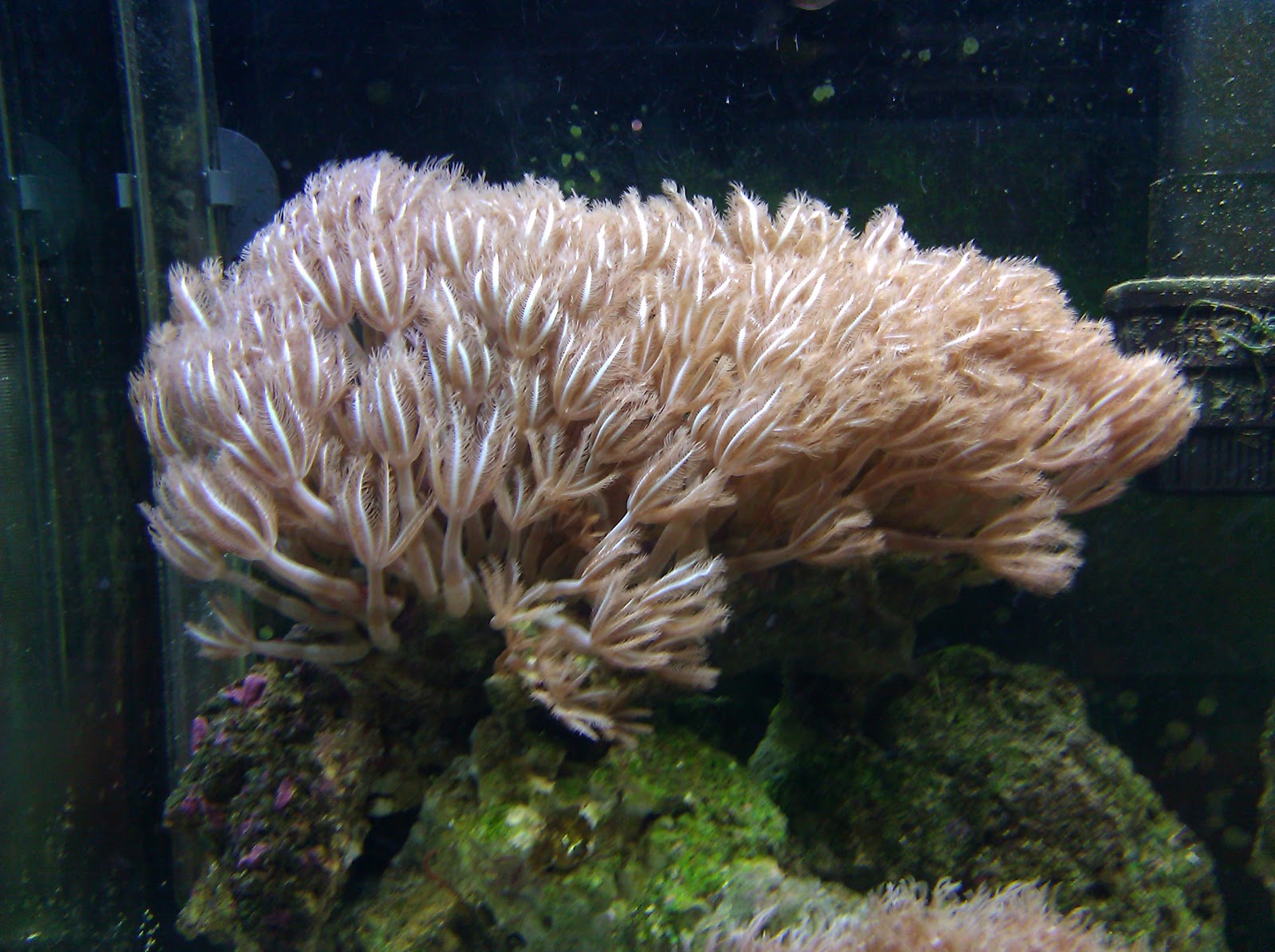
Anthelia Update

Anthelia BeforeAnthelia Current
Not much to say about the Anthelia except it, too, has gotten more dense. I suppose it's only a matter of time before they start removing themselves from the colony and setting up shop elsewhere in the tank.

Star Polyp Update
Star Polyp BeforeStar Polyp Current
This may not be a fair comparison - the image on the left is effected my a majano anemone (just right of center) and a few aiptasia (left edge).  There are still a few aiptasia on the current photo but their placement does not effect the polyps as much as before.  I don't know if I necessary noticed this coral spreading, but in the places it is, it certainly looks better.  Also picture at the bottom left of the rock, a calciferous worm has taken up residence.  That is the horizontally running "white tube" just to the left of the bottom-most cluster.

Neomeris annulata update


N. annulataN. annulata Current
The single "seedling" bleached out after the first picture was taken.  It happened during a time when the power filter was put back into use.  This tells me that nitrates need to be at or below 20 to have this algae.  The current picture isn't the best, but it's amount of spread can be distinguished by color alone.  Nitrates run no higher than 20 in the current setup.


Here's how the anemone is doing.  The male clown can be seen underneath and to the left tending to the eggs they've recently laid.

This particular rock has a sponge that is getting bigger.  It's also accumulating a lot of pineapple sponges.

Monday, April 11, 2011

Potential Anemone Preventative Care

Just a few (hopefully) quick things...

Noticed the anemone has had some what appear to be "irritated" tentacles.  They are shriveled and white.  I've noticed the clowns picking on those tentacles the last couple days.  Those tentacles just so happen to hang over the bowl edge to where they may be coming in contact with the anthelia.  I don't know if anthelia "stings" or not, but I moved it away from the anemone bowl.  I haven't yet looked to see how much flow the anthelia requires.  It's in "low" flow now, so I may end up moving it again to a better flow spot.

Since I moved the anthelia, I'm thinking of moving the remainder of the rock adjacent to the anemone bowl to avoid future coral contact.  That will be for another day.

I scrubbed cyanobacteria from a few of the rocks also.  While I was at it I went ahead and kept on brushing. Did all the rocks except the anemone bowl.  If the power filter wasn't installed, I probably would not have done that just due to the amount of detritus that was stirred up.  So now I'm waiting for the "dust to settle" so that I can hand out some mysis.

The surface film on the tank was about 75% gone... at least until I started stirring up the substrate and brushing rock.  I don't like stirring all that stuff up at once.  I don't know what effect it has on the inhabitants.  Maybe I'll start spreading it out over the course of a week instead of everything at once.  Speaking of which, I expect a pretty full skim cup tomorrow.

Nitrates are still at 10.  Just another patience game to play with the chaeto.

Found a dead shrimp today.  Judging by the location of the shrimp I see on a daily basis, I'm guessing the carcass I found was the new one.  Time to update the tank specs to reflect the change.  I still think I need to have a total of at least 4 just to keep the "territory" covered.  But those will have to come with time.

The first shrimp I got was a nice pink, even during acclimation.  The second shrimp was brown the whole time until it was in the tank for 10 minutes or so.  Then it turned pink, but I wonder if that had anything to do losing it.

I suppose that's it.

Wednesday, April 6, 2011

2nd Attempt at Power Filter Removal - Part IV

Tank is still looking good and the water tests have surprised me a bit:

With not feeding yesterday (to assist the tank with the removal of all that aerobic bacteria living in the filter), the ammonia level remained undetectable.  Good.  We'll see what it is tomorrow after feeding a single mysis cube.

With ammonia in check, the remaining partners in the nitrification cycle should remain in check, as well.  Nitrites were the same as yesterday, as were nitrates.

With the water change and lack of introduction of food, phosphates dropped a bit from an estimated .125ppm to .06ppm (instead of being 'in between' 0 and .25, it's now a closer color to 0, but not quite 0).

What really surprised me was a lack of skim.  I'm usually dumping 3/4" to an inch of skim a day.  Today's was 5/8", so just over one half.  Once again, probably attributed to a lack of feeding yesterday along with a good substrate vacuum.

We'll see how levels progress with minimal feeding for the next week or so and see if this I'm doing the tank better.

Here's how things look today:


2nd Attempt at Power Filter Removal - Part III

I double-checked with the wife about halfway through my shift for a report on how cloudy the tank was.  She said it wasn't cloudy at all and that it actually looked good.

Sigh of relief.

Finally got home, and yes it does look good.  Perhaps the combination of removing the power filter AND changing the water did the trick.  This time the tank has a chance to start at near-zero readings (at least with ammonia, nitrites and phosphates) with the power filter gone.  I also checked the skim cup.  It's at almost an inch I'd say.  That would bring my new "daily skim norm" to at least 1 inch, maybe 1.25 to 1.5 inches.  We'll see.

The daylights have long been off today, as have the actinics.  The moonlit tank is what greeted me upon arrival home tonight.  Granted, it's different lighting (same exposure though), but here's how the tank looks now:

Water has cleared up. No light beams shining down,
at least that are perceptible to the camera like in the prior two photos.
I'm anxious (and then again not) to see what water readings are going to be for the next week or two.  And then it'll be nice to know the new tank's 'routine' so that I can lighten up on the testing, getting back to once or twice a week.  I think until I get a bigger skimmer, it might be stretching it to check once a week on a continual basis.  Perhaps I can get by with 3 tests every 2 weeks, but I dare not go further than that, at least until it finishes up this newest mini-cycle.

I'm mostly curious how nitrates are going to behave.  I still had a reading of 10ppm after removing the filter and then performing a 15% water change.  So it's going to take at least one other water change to remove traces of them.  With the power filter, I didn't seem to gain much ground with water changes unless nitrates were at least 20ppm.  I'm curious of the headway I'll be making with water changes now.  If after another couple changes I still have traces of nitrates immediately following the water change, I'll probably head down to the LFS and pick up a fist-full of chaeto macroalgae.

Also due to the removal of the filter, I also fasted the inhabitants today.  Since no one ate today, I should probably feed them something that everyone enjoys tomorrow - so not ZooPlex.  I think a mysis cube will do well.  I'm going to put them on a rotating regiment - mysis one day, krill the next, then zooplex.  Rinse, repeat.  We'll see how the variety of diet goes with the inhabitants and the water column.  And for the remainder of this week, as hard as it may be to keep my finger out of it, I will refrain from feeding the anemone directly.  Time to put the Clowns to work.

The aiptasia-dodging shrimp pair are another story, however - I mean, come on!  Do I seriously need an army of shrimp to rid the tank of aiptasia???

Don't answer that.

Sunday, April 3, 2011

One Aiptasia Down and Analyzing the Future

As before, I have 3 visible aiptasia.  Two on the left side of the Star Polyp Coral and one on the back of the anemone's bowl.  I witnessed the Peppermint Shrimp on the back of the bowl last night and noticed the aiptasia wasn't visible.  But I wasn't sure if I just couldn't see it due to the Moonlight LEDs.

I checked again this morning once the actinics kicked in, and I'm pretty sure it's gone.  I'll double check later on in the week, but I think the shrimp just started paying rent.

Parts of the anemone didn't look so hot when I got home.  It's left quarter appeared deflated, though the remainder of it looked very nice and healthy.  I went ahead and hand-fed it.  It didn't close up on me though.  And then a bit later the mama Clown fish began to eat what I had put near it's mouth.

Maybe I should quit stressing about the anemone and just let the clowns take care of it.  The previous owners said they never lifted a finger for it.  I think I'm game to try that for a week or two.  I'll watch to see if the Clowns feed the anemone.  If the path of least resistance gets me to my goal quicker, why not?

I was thinking last night what I'm going to do if that thing ever splits...  it HUGE.  It's gotta be 10-12" in diameter.  Hopefully I'll be one of the lucky one's in which the 2nd anemone resides close to the original - meaning it split for good reasons, not for bad.

Since I now have a phosphate test kit, I tested my tap water.  No phosphates. There are probably other things in the water that don't need to be, but at least I feel assured I'm not adding to the phosphate levels in the tank by using tap water.  That only leaves food as the source of new phosphates, and I've never been accused of starving fish, so I could get that under more control easily.

I find it strange, though, that after the last water change I had 0 phosphates.  The next day I'm at about .125 ppm, and so far it's just plateaued from there.  I'm beginning to think my rock is the primary source of phosphates in the water since it reappeared then leveled off.  If it were food, it would steadily increase every day.  We'll see what it's at before the next water change, which is in 5 days.

My hypothesis is that if the level of phosphates is still .125, my feedings are having a negligible impact on phosphates, meaning the levels are coming from the rock and substrate.  Or at least the diatom and cyanobateria are keeping up with food phosphates.

I'm a ways off from doing anything big with the tank, if ever.  I'm asking myself "what's my biggest problem in the tank?".  Hard to say right now, since I don't perceive the tank as having a major AND permanent problem.  Sure the diatoms and cyanobacteria are annoying, but they will pass.  It's like the tank has started another cycle since I added that last 15 lbs of rock.  Then more inhabitants came before that cycle ended and I'm back to square one.  So time should heal the brown and red colors.  Easy - time is free.

The next biggest issues I see are tied.  Nitrate levels, Ammonia levels, and phosphate levels.

Ammonia levels will eventually work themselves out.  Given enough time, the proper bacteria will grow to meet the demand of ammonia levels.  Once again, time is my friend.

Nitrate and phosphate levels will probably always be around either from food or from rock.  I know some believe macroalgae to be a bandaid (myself included), but exporting nutrients via micro or macroalgae is a legitimate practice (just one of many sources).  The key is to actually export it via harvesting, not to let the macroalgae grow to the size of a basketball... and I think that's where I become seemingly hypocritical.  I agree with it's use as long as it's harvested (removed), but not with it's presence for the sake of presence.

So perhaps the next thing I'll do is devise a rod on a suction cup to pin the chaeto to the side of the tank.  If it's mounted in the right spot close to a powerhead, it will spin.  Who knows...

And with the phosphates and nitrates being taken in by macroalgae, perhaps my browns and reds will dissipate sooner.

(I'm still back and forth about adding pods to the chaeto)

Moonlight Views

Got home tonight after the actinics turned off, so it was just the moonlight LEDs lighting the tank.

Even with 1 LED per 12" of linear tank, there are still a lot of details to be seen, especially after a person's eyes adjust to the lack of light and begin to focus on moving shades of grey.

I noticed the new Peppermint Shrimp at the left side of the tank.  As it was inspecting the rock, it came across one of the Brittle Starfish legs.  He began to "box" with the starfish, but the starfish leg went limp and began to curl in the flow.  Almost immediately the shrimp apparently realized the leg was nothing interesting.

A few minutes later the shrimp actually crossed over the starfish and changed rocks.  Good, I'm thinking.  That's the rock with aiptasia.  The rock is about 8 inches in length with the aiptasia on the left edge.  The shrimp was on the right edge.  It crossed along the front of the rock for just a couple of inches, then left the rock and began weaving across the substrate toward the front of the glass...  so the aiptasia lives yet another day.

A while after that the shrimp appeared on the anemone bowl, inspecting the front side.  After a few minutes of this, the shrimp began to get higher and higher on the rock, approaching the edge of the bowl.  Mama Clown just so happened to be on watch just above the shrimps position.  I could see her notice the shrimp's antennae weaving back and forth as appeared over the edge.  A few seconds after noticing, Mama Clown exited the anemone to see what exactly it was.  The clown and shrimp met at the edge at the same time.  A couple head-butts from the clown and the shrimp disappeared behind the Encrusting Anethelia.

So it seems the shrimp is acclimating to it's environment nicely.  We should probably get a few more.  Most of the live rock is not stacked, which leaves a lot of no-mans-land that cannot be reached to be cleaned or vacuumed.  Detrivores will be needed to assist in these areas.  Also, Peppermint Shrimp claim a territory of about 12".  To evenly distribute shrimp across the entire tank, 4 would be needed.

I've also been reading about how the shrimp generally won't dine on larger aiptasia... which is disappointing.  In my opinion, two of the three visible aiptasia are "not small".  So perhaps I'll be entering the tank (or pulling the rock they live on) to at least partly remove the current aiptasia (knowing I will not possibly be able to completely remove it) so that they may grow back smaller & more appealing to the shrimp.  I'd do it right now if the starfish wasn't in the way...

The glimmer of Moonlight LEDs from the photosynthetic cyanobacteria.

Friday, April 1, 2011

Water Conditions et al

Nothing much going on, so here's todays water conditions and some photo's.  This weeks water change has just been completed.  I wanted to wait on the water testing until after the change to have a starting point.  I normally do 5% per week (4 gallons), but today I did a 10% change - I forgot to remove the detritus from the power filter and needed some more water.  And since I was in there a second time, why not vacuum the other half of the tank...

Ammonia - .25 ppm
Nitrates - 10 ppm
Phosphates - 0 ppm
Nitrites - 0 ppm
Alkalinity - 300 ppm
pH - 8.4
Specific Gravity - 1.0235
Skim Level - 7/8"

I think it's interesting to watch the history of the water conditions.  It's a textbook study of causality.


While watching the tank feast on ZooPlex, the Brittle gave me a wave.

Not only do the Clowns seem to love ZooPlex, the anemone seems to enjoy it as well.
Here it's folding up a bit, presumably to ingest some ZooPlex that it's caught.

I guess feeding for the anemone allows the Clowns to do a little housekeeping underneath.

WARNING - DRY SCIENTIFIC CONTENT BELOW, SOME OF WHICH IS MORE OR LESS ACCURATE

Let's start at the beginning of the nitrogen cycle:

  • Before adding the new inhabitants, skim levels were about where they are now.  Prior to the new inhabitants, I attributed the higher DOC levels to baterial die-off - without fish (only crabs) there was a lot less ammonia to feed the ammonia-consuming bacteria.  Now I think the opposite is happening.  There are inhabitants, they are being fed, and DOC levels have -at least- remained the same (sometimes spiking).  With this amount of feeding and inhabitants, about 1" of skim level is expected to be the new norm.
  • Ammonia levels were at zero prior to the inhabitants.  They initially rose to .25 ppm with the addition.  Then the cloudy water day happened and I surmise they peaked at .5 ppm.  Ammonia is still present in the tank at .25 ppm, so it appears as though my tank is going through another cycle (the ammonia-converting bacteria has yet to catch up with the new load)
  • Nitrites are the next step in the cycle.  Lately my nitrites have been at zero, meaning I have all the nitrite-converting bacteria that is needed with this load.  With no nitrates in the water, all are being consumed and converted into nitrates.
  • Nitrates are next.  I surmise I will always have nitrates until I remove the power filter.  The power filter can easily house the bacteria that converts ammonia to nitrite and nitrite to nitrate, but not so much with the bacteria that converts nitrate to nitrogen gas.  Those bacteria need a oxygen-deprived area to live.  A power filter with constant flow is not an inhabitable environment for those type of bacteria.  However, the nitrate-consuming bacteria that live in the live rock are the one's keeping the nitrates from collecting faster than they already do.  They live next to the nitrite converting bacteria.  Once nitrate is produced, it is handed off to the nitrate converting bacteria.  Nitrate in the water does not have the chance to make it to it's host bacteria since that would take some sort of flow.  Water flow contains oxygenated water, and those bacteria cannot live in oxygenated environments...  See why I want to remove the power filter?  I will still need some sort of particle filtration (aka sump), which is why it's back in the tank now.
  • Phosphates are necessary, but only in minute quantities.  I have none in the water (after the water change), which is good.  Like nitrate, that simply means I don't have any "unused" phosphates.  They are still in the tank, just not in the water.  Phosphates are locked up in the live rock and substrate, in the flora, and in the fauna (due to them receiving it via food).  Yesterdays test had .25 ppm of phosphates in the water.  Today I'm back at zero (or very close).  That tells me everything is saturated with the phosphates because it was in yesterdays water.  With more time, it will be interesting to see phosphate in my causality scheme.

A Prehistoric Treat & Some Eye Candy

The Peppermint Shrimp, who has yet to earn his keep, came out from the rock he's been hiding under since acclimation to grab something, then retreat back to his hole.  I got a much better picture of him.

We were treated tonight to an early emergence of the Brittle Starfish as the Clown fish entertained us by skimming the half pipe of which the anemone resides, only to be interrupted by a starfish leg which they promptly shoo'd away.


And the photosynthetic bacteria of the Red Slime Algae glimmered in the Moonlight LEDs to top off the night.


This saltwater world can truly be amazing.

Thursday, March 31, 2011

T plus 89:00

It's been 89 hours since the cloudy tank was discovered, and 89 hours of closely monitoring the anemone.

By the time I'd gotten home from a short day of work the daylights had already had their 4 hour cycle.  The anemone still looks nice and full, even if a little "pale".  I bumped up the light timer one notch, which is 20 minutes or so (I think there are three notches per hour, but it's hard to tell).  I'm going to keep bumping it one notch a day until the anemone begins to shrink - a sign that it's getting too much light.  Then perhaps we'll start the additional hour per week for light acclimation.

I had enough things to do on my "need to get" list that I dropped by my LFS.  The atmosphere was a nice one today, I must say.  The owner was not around, but his wife was.  We swapped a few stories - she said she walked in today to what she thought was a shrimp birth...  Hundreds of these things swimming around.  It was neat to hear how excited she still gets with saltwater discoveries like that.  It gives me hope this hobby won't get old, at least for my wife and me.

I grabbed a phosphate test kit from the get-go, and the browsed while she helped the customer before me.  I spotted the Peppermint Shrimp and eyed them quickly before searching for their price.  Ten dollars each, or three for $24.  Phosphate kit was also ten bucks. So far so good... can't spend too much.  I told her about the tribulations with the anemone.  She conveyed a couple anecdotes about her experiences with anemones.  The moral of her story was that if it were going to die, it would be obvious.  Good news there.

While I was there, I inquired about the Cardinals.  They've only snacked a bit here and there for the last week.  I asked what they use to feed theirs - she said "Krill".  I have Krill pellets... "No, I mean Krill".  Show me this Krill.  She produced a can of freeze dried krill.  I quickly scanned the ingredients - krill and a vitamin supplement.  She demonstrated how to feed krill on their clown/anemone tank.  To my surprise, she placed the last bit of krill right into the anemone.  It closed up on her fingers and she pulled her hand out.  Wow, I haven't yet gotten the nerve to do that.

I told her if the Cardinals keep snacking this week, I'll be in for some.

I explained my concerns for the anemone being bleached and told her I've read they can be nursed back as long as they are target fed everyday - I've heard of using Mysis Shrimp for this.  She agreed that they love it and produced a frozen package of it.

Out the door for $28 and change and had one of the most reassuring and informative visits I've had in a little while.

Once I got home my wife was excited to hear the story about the owners wife hand-feeding their anemone.  She wanted to try it.  She did so successfully.  She even played a bit with the tentacles.  I asked if they were sticky or slimy.  They're sticky - good!  The Clowns had some of the shrimp, but not much.  The Cardinals weren't interested in it at all.

The Peppermint Shrimp, once in the tank, headed to the opposite end of the tank as the aiptasia, so no aiptasia will be consumed today.  And the small cloudy white snail we saw a week or to ago... Found it on the glass today.  The shell is beginning to become pronounced.  From the looks of it, it could be a Chiton, Limpet, or Stomatella.  As it matures, I'm sure it will become obvious.

Here are some photo's from this afternoon:
The Brittle Starfish made a small appearance this afternoon.

Here is the side view of the "Snail" we saw a couple weeks ago.

Here is the underside of the unknown "Snail".

Wasn't thinking too well.  It's the only picture so far of the Peppermint Shrimp.

Wednesday, March 30, 2011

T plus 56:00

After looking at some before and after shots, I started to get concerned about the anemone beginning to bleach.

March 26, Day 1

March 29. Day 4

March 30, Day 5

After doing a little research on how to care for bleaching anemones, a product name rang a bell with me.  Someone had mentioned ZooPlex, which just happened to be on my list of additives/foods to research.

I followed the directions, adding 2 tablespoons of ZooPlex to the tank after shutting off the skimmer and power filter.  The clowns went crazy for it.  And my research shows if the clowns are happy, the anemone is happy.

Woke up this morning and took a few shots, plus a video of the clowns feeding on the ZooPlex.  I must say, the anemone is turning from a light blue (white reflecting the actinics) to a nice fleshy tan again.  It still has a few problematic (short or deflated) tentacles, but hopefully with the new diet the Clowns are providing, the anemone will begin to regenerate itself.

And tomorrow I'm probably back to worrying...


Tuesday, March 29, 2011

Anemone's and Sanity

Got home and fed the fish.  The cardinal's still aren't eating much, but the Clown fish are beginning to - but only if I drop the food in just the right spot.  Heaven forbid they wander too far from the anemone to pluck food from the water.

Before feeding the fish, the anemone looked so-so.  No real change.  After feeding, however, it seemed to inflate again, but nothing compared to it's original fresh-in-the-tank size.

The back-and-forth is making me crazy.  I hope the anemone wins the waiting game we're playing.

Here are snapshot's of how the anemone and corals are doing:


The anemone's tentacles are inflated and extended nicely.  This morning some tentacles were short and thick, others were long and thin.  These are looking nice at the moment (at least in my opinion).  It appears as though the anemone is bleaching, though.

The Star Polyp is looking good.  Most of the polyps are open.

It appears as though a couple of polyps are bleaching.  I'll be keeping an eye on it.
EDIT - They aren't bleaching.  They tend to "whiten up" when in transition
between being fully open and fully retracted.